Expanding your gaming chair business feels exciting, but the maze of international regulations can be a headache. A single missed certificate can stop your shipment cold. Let's make it simple.
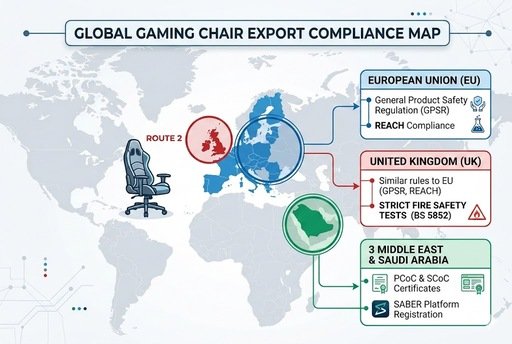
To export gaming chairs, you must meet specific regional standards. For the EU, comply with the General Product Safety Regulation (GPSR)1 and REACH2. For the UK, follow similar rules but add stringent fire safety tests (BS 5852). In the Middle East, especially Saudi Arabia, you'll need certificates like PCoC and SCoC3 through the SABER platform4.
I've spent years navigating these rules for our clients at Ergomakers. It can seem like a lot, but once you understand the core requirements for each market, the path becomes much clearer. We are going to look at each region one by one, so you know exactly what to prepare. Let's start with the European Union, a massive market with some very specific new rules.
How do you make your gaming chairs compliant for the EU market?
The European Union is a huge opportunity, but its regulations can feel overwhelming. You worry that a small oversight in your paperwork could get your products stuck at customs. Here’s a clear guide to get it right.
For EU compliance, your main focus should be the General Product Safety Regulation (GPSR)1. This requires a risk assessment and technical files. You also need to adhere to REACH2 for chemical safety and test against EN standards like EN 13355 to prove your chair is safe and durable.
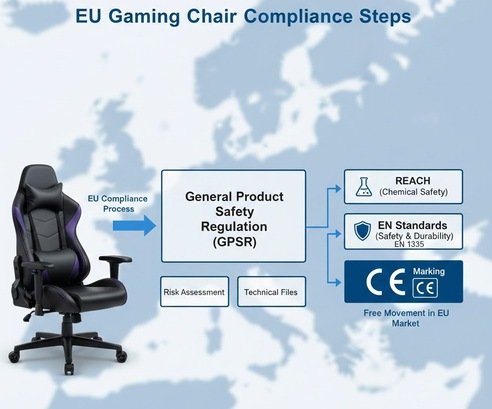
The EU has really tightened its rules. The new GPSR, mandatory from December 2024, is a big change. I remember our team working through the first GPSR assessment; it forces you to think about every possible risk. You have to create a technical file that includes your risk assessment, test reports, and material specs, and keep it for 10 years. If you're a manufacturer outside the EU, you must appoint an EU-based representative. This person is the legal contact for authorities. Then there's REACH2, which limits harmful chemicals. We always test our foams and fabrics for substances like formaldehyde and certain dyes. While EN standards like EN 13355 are technically voluntary, they are the best way to prove your product meets GPSR's safety requirements. Any chair with electrical parts, like RGB lighting, also needs a mandatory CE mark.
Key EU Compliance Checklist
| Regulation/Standard | What It Covers | Key Action for You |
|---|---|---|
| GPSR | Overall product safety | Conduct a risk assessment, create a technical file. |
| REACH2 | Harmful chemical limits | Test materials for restricted substances. |
| EN 13355 / EN 125206 | Strength, durability, stability | Perform tests to show your chair is physically safe. |
| CE Marking7 | Electrical safety (if applicable) | Ensure parts like USB ports or lights meet LVD, RoHS, EMC. |
What are the specific rules for exporting gaming chairs to the UK?
The UK market is very similar to the EU, which can make things confusing. You might assume the rules are identical, but a critical difference could lead to rejected shipments. Let’s pinpoint what makes the UK unique.
To export gaming chairs to the UK, you must comply with UK GPSR and UK REACH2, which mirror the EU versions. The most important difference is the strict Furniture and Furnishings (Fire) (Safety) Regulations 19888. Your chair's upholstery and fillings must pass the BS 5852 fire resistance test9.
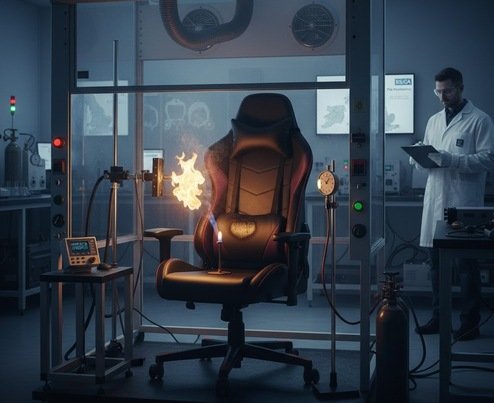
After Brexit, the UK created its own versions of many EU laws. So, you'll see UK GPSR and UK REACH2, which are almost the same as their EU counterparts. You still need to do a risk assessment and manage chemical safety. However, the UK's fire safety rules are much stricter than in the EU. This is the one area I always tell our clients to double-check. The regulation requires that the foam and fabric used in upholstered chairs can resist catching fire from a match and a cigarette. This is verified through the BS 5852 test. You must attach a permanent label to the chair confirming it meets these fire regulations. For any electrical components, you will need a UKCA mark10, though for a certain period, the CE mark may still be accepted. It's always best to check the latest government guidance on this.
UK vs. EU Compliance at a Glance
| Requirement | United Kingdom (UK) | European Union (EU) |
|---|---|---|
| General Safety | UK GPSR (similar to EU) | GPSR |
| Chemicals | UK REACH2 (similar to EU) | REACH2 |
| Fire Safety | Mandatory & Strict (BS 5852) | Less strict (EN 1021) |
| Electrical Mark | UKCA Mark (CE may be accepted temporarily) | CE Mark |
What certificates are needed for the Middle East market?
Selling in the Middle East is a fantastic goal, but there isn't one set of rules. Each country has its own system, and you're unsure where to even start looking. This uncertainty can stop your expansion plans.
For the Middle East, compliance is country-specific. For Saudi Arabia, you need a Product Certificate of Conformity (PCoC) and a Shipment Certificate of Conformity (SCoC) via the SABER platform4. For the UAE, certification is less often required for non-electrical furniture but is still recommended.
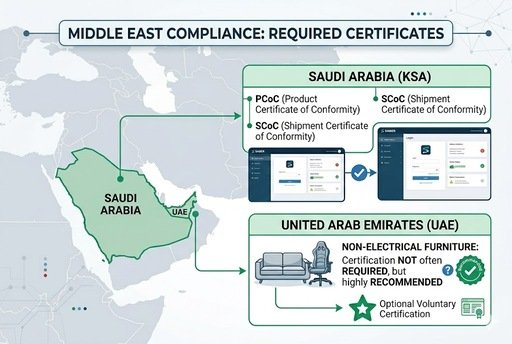
Unlike the EU or UK, the Middle East doesn't have a unified system. Saudi Arabia and the UAE are the two biggest markets, and they have the most defined processes. Saudi Arabia's system is called SALEEM, and you use an online portal called SABER to manage it. We help our clients with this all the time. First, their Saudi-based importer registers the product on SABER. Then, we provide technical documents and test reports (often based on EN standards) to a SASO-approved body. They issue a PCoC, which is valid for a year. For every single shipment, you then need to get an SCoC. Without these two certificates, your goods will not clear customs. For the UAE, the system is called ECAS. Most non-electrical furniture is not a regulated product, so you often don't need a mandatory certificate. However, if your chair has lights or massage functions, it will fall under their electrical regulations.
| Country | Governing Body/System | Required Documents | Key Notes |
|---|---|---|---|
| Saudi Arabia | SASO / SALEEM (SABER Platform) | PCoC + SCoC | Mandatory for most gaming chairs due to high textile content. |
| UAE | MoIAT11 (ECAS System) | ECAS/EQM Certificate (if required) | Not usually mandatory for non-electrical furniture. |
| Other GCC | Varies | G-Mark12 (for electrical), CoC | Requirements often similar to Saudi Arabia; check with local importer. |
Conclusion
Navigating EU, UK, and Middle East compliance requires attention to detail, but it's achievable. Focus on GPSR in the EU, fire safety in the UK, and certificate systems in the Middle East.
Understanding GPSR is crucial for ensuring your gaming chairs meet EU safety standards, preventing shipment delays. ↩
REACH compliance ensures your products are free from harmful chemicals, a key requirement for the EU market. ↩
These certificates are mandatory for clearing customs in Saudi Arabia, making them vital for market access. ↩
Using the SABER platform is essential for obtaining necessary certifications for Saudi Arabian market entry. ↩
Adhering to EN 1335 proves your chairs' safety and durability, aligning with EU compliance requirements. ↩
Complying with EN 12520 ensures your furniture meets EU standards for strength and durability. ↩
CE Marking is mandatory for electrical components, ensuring compliance with EU safety regulations. ↩
These regulations are key for ensuring your gaming chairs meet UK fire safety standards. ↩
Passing the BS 5852 test is essential for UK market entry, ensuring your chairs meet strict fire safety standards. ↩
The UKCA mark is crucial for electrical safety compliance in the UK, replacing the CE mark post-Brexit. ↩
MoIAT oversees product certification in the UAE, crucial for understanding local compliance needs. ↩
The G-Mark is essential for electrical product compliance in the GCC, ensuring market access. ↩